
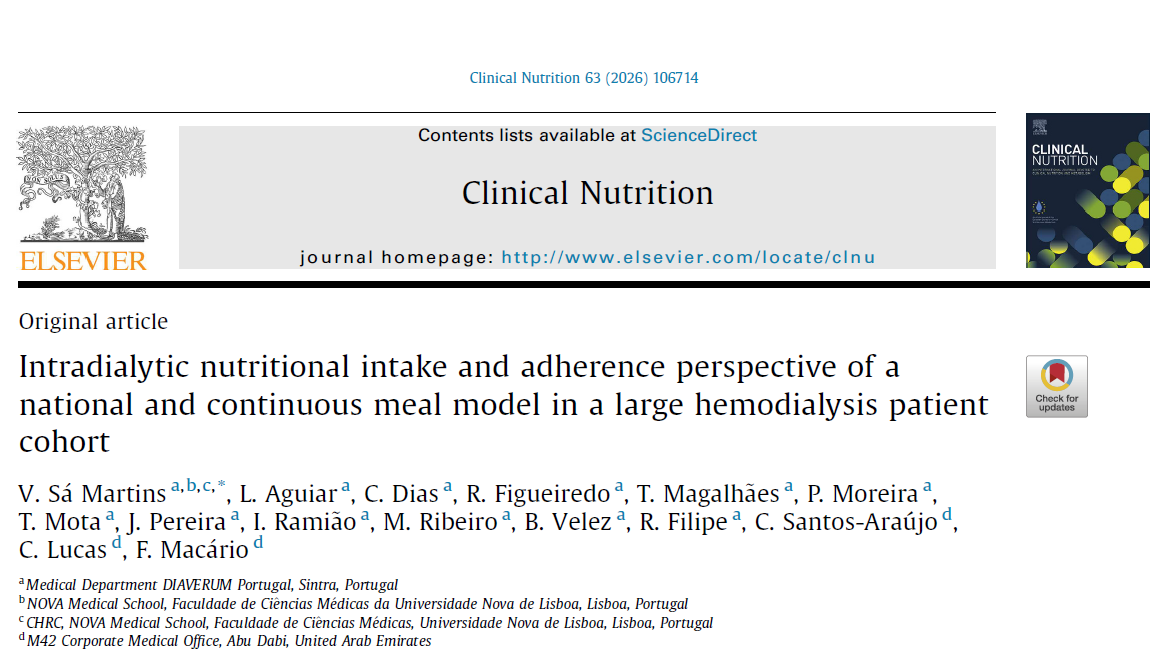
Diaverum Portugal has had its national study on the intradialytic snack model published in Clinical Nutrition (IF 7.9), the official journal of the European Society for Clinical Nutrition and Metabolism (ESPEN). The study evaluated the intradialytic snack model implemented across all our clinics more than a decade ago.
This study represents one of the largest analyses ever published on oral nutritional support and food intake during haemodialysis treatment.
Why is eating during treatment important?
Beyond the nutritional comfort provided by having a meal during treatment, the intradialytic snack is important to compensate for the energy and protein expenditure associated with each haemodialysis treatment — approximately an additional 300–320 kcal (1) and 6 to 12 g of amino acids (2) per treatment. It therefore plays an important role in maintaining and rehabilitating the nutritional status of the people we care for.
Our “Patient Preferences and Food First” model
Based on informed autonomy supported by ongoing education and health literacy, and always with nutritional goals aligned with each person’s clinical condition, snack selection is based on the patient’s preferences within an established model that offers considerable dietary variety.
Key findings of the study
Adherence to intradialytic food intake is particularly high: 97% of the people we care for who have no contraindications preventing them from eating during treatment choose to have a snack. Two thirds of these patients choose a snack that simultaneously compensates for the increased energy and protein requirements associated with dialysis treatment, supported by ongoing nutritional monitoring and counselling from our team of dietitians.
In this analysis, median intake per session was 358 kcal, 12.7 g of protein and 4.2 g of fibre. Potassium and phosphorus intake remained within clinically safe ranges.
Two findings that we consider particularly relevant further reinforce our patient-centred nutritional intervention strategy:
1. Intake decreases with age: there is a significant reduction, with approximately 19% lower odds of meeting the target for each additional decade of age. This highlights the need to prioritise nutritional counselling focused on meeting daily energy requirements and the use of supplementation among older people.
2. The greater the exposure to food literacy and nutritional counselling, together with longer time on dialysis, the more appropriate the choices: this confirms that food literacy is an ongoing process, built over time, and that consistency also plays an important role.
For more information about the study, please visit:
An achievement for our teams
This work is the result of the daily commitment of our dietitians, the wider clinical teams and the involvement of the people we care for — without whom none of this would have been possible.
Congratulations and thank you to everyone involved.
(1) Ikizler TA, Wingard RL, Sun M, Harvell J, Parker RA, Hakim RM. Increased energy expenditure in hemodialysis patients. J Am Soc Nephrol 1996 Dec;7(12):2646–53.
Study DOI
(2) Ikizler TA, Flakoll PJ, Parker RA, Hakim RM. Amino acid and albumin losses during hemodialysis. Kidney Int 1994 Sep;46(3):830–7.
Study DOI
Further publications from the Diaverum Nutrition Service
- Sá Martins V, Aguiar L, Dias C, Lourenço P, Pinheiro T, Velez B, Borges N, Adragão T, Calhau C, Macário F. Predictors of nutritional and inflammation risk in hemodialysis patients. Clin Nutr. 2020 Jun;39(6):1878-1884. https://doi.org/10.1016/j.clnu.2019.07.029. Epub 2019 Aug 6. PMID: 31427179.
- Sá Martins V, Adragão T, Aguiar L, Fortes A, Costa M, Borges N, Calhau C, Macário F. Can an intradialytic snack model compensate the catabolic impact of hemodialysis? Clin Nutr ESPEN. 2021 Apr;42:292-298. https://doi.org/10.1016/j.clnesp.2021.01.018. Epub 2021 Feb 5. PMID: 33745595.
- Sá Martins V, Adragão T, Aguiar L, Pinto I, Dias C, Figueiredo R, Lourenço P, Pascoal T, Pereira J, Pinheiro T, Ramião I, Velez B, Papoila AL, Borges N, Calhau C, Macário F. Prognostic Value of the Malnutrition-inflammation Score in Hospitalization and Mortality on Long-term Hemodialysis. J Ren Nutr. 2022 Sep;32(5):569-577. https://doi.org/10.1053/j.jrn.2021.11.002. Epub 2021 Dec 23. PMID: 34922814.
- Aguiar L, Sá Martins V, Pinto I, Papoila AL, Dias C, Figueiredo R, Pereira J, Ramião I, Velez B, Adragão T, Borges N, Almeida E, Garrido J, Macário F. Nutritional risk assessment in hemodialysis patients: A comparative analysis of modified creatinine index, geriatric nutritional risk index and simple protein-energy wasting score with malnutrition-inflammation score. Clin Nutr ESPEN, 2025, 66: 429-436 https://doi.org/10.1016/j.clnesp.2025.02.003


